
Why speed decides e-commerce revenue
In a physical shop a slow queue annoys customers; online, it silently empties the cart. Study after study shows the same pattern: as pages get slower, more shoppers abandon before they buy, and the effect is sharpest on mobile, where most retail traffic now happens. A store that loads in one second converts far better than the same store loading in three or four.
Speed also shapes how many people ever reach your products. Google uses page experience — including Core Web Vitals like Largest Contentful Paint — as a ranking signal, so a faster store tends to rank higher and earn more organic traffic. Speed is not a technical nicety; it is one of the highest-leverage things you can improve in an online business, and it compounds with everything else you spend on ads and marketing.
What actually slows an online store
Three things dominate. First, images: product photos, galleries, banners and thumbnails are usually the heaviest part of a store, and shipping them uncompressed, in old formats, at full resolution wastes seconds on every page. Second, distance: if your server sits in one place and your shoppers are spread across a country or the world, each request pays for the round trip. Third, dynamic work: a store platform rebuilds pages with code and database queries on every visit, which is fine for one shopper and painful during a rush.
Traffic spikes make all of this worse at exactly the wrong moment. A campaign email, an influencer post or a flash sale sends a wave of visitors, the origin server strains to rebuild pages and re-send the same images, response times climb, and some shoppers see errors or give up. The fix is to do less repeated work and to serve as much as possible from somewhere close to each buyer.
How a CDN speeds up your store
A CDN (content delivery network) puts copies of your content on edge servers spread across many locations, then serves each shopper from the nearest one. Instead of every product image and stylesheet travelling from a single origin, they are delivered from an edge a short hop away — so pages paint faster and your origin handles far less load.
Crucially, a CDN knows the difference between content that can be shared and content that must stay personal. Static assets — product images, CSS, JavaScript, fonts — are cached at the edge and reused for everyone. Dynamic, per-shopper responses — the cart, the logged-in account, the checkout — are passed through to your store so prices, stock and totals are always correct. Done right, a CDN makes the browsing experience fast for everyone while keeping the buying experience accurate for each person.
cdn.com.tr runs a Turkey-based edge network with global reach, so Turkish shoppers are served locally and international customers are served from nearby regions. You route your store domain through the CDN and the edge begins caching and delivering your catalogue automatically — usually with no code changes to the store itself.
Image optimization: the biggest single win
For most stores, images are the largest thing on the page, so optimizing them moves the needle more than almost anything else. Optimization means three things working together: compressing images so they carry less data, converting them to modern formats such as WebP that are dramatically smaller than old JPEG/PNG at the same quality, and sending an appropriately sized image instead of a huge original scaled down in the browser.
The payoff is direct: lighter product and category pages, faster Largest Contentful Paint, less mobile data burned, and a better Core Web Vitals score that helps you rank. The best part is that it should be automatic — you upload your product photos once and the platform delivers the optimal version to each device and browser.
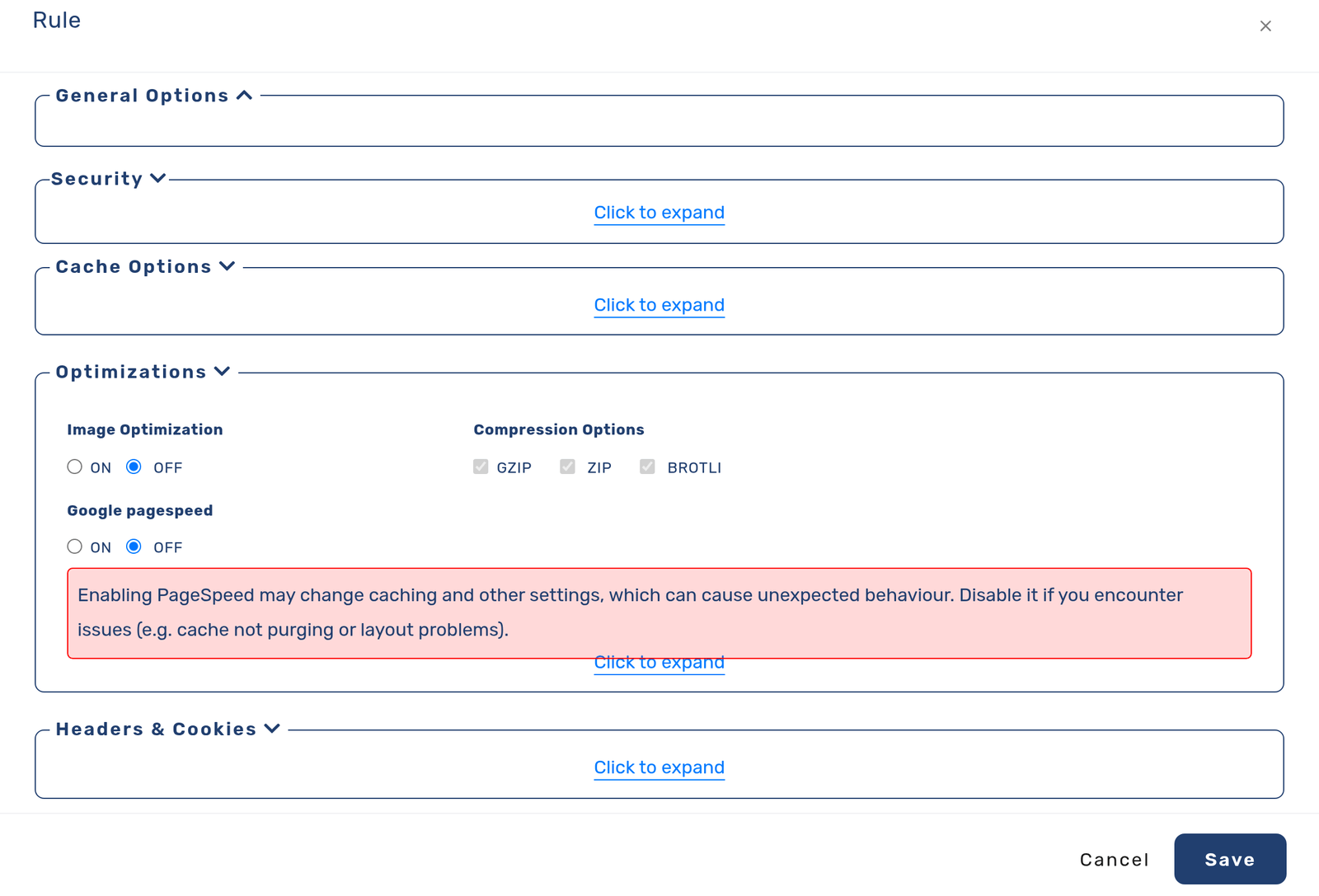
cdn.com.tr includes image optimization at the edge, so your product imagery is compressed and served in modern formats without you exporting a dozen variants by hand. You keep your originals; shoppers get the fast, small version suited to their screen.
Security and trust: WAF, DDoS and SSL
An online store is a target: it takes payments, stores customer data and depends on being reachable. Three protections matter most. A Web Application Firewall (WAF) inspects incoming requests and blocks common attacks — injection attempts, malicious bots, credential stuffing against login and checkout — before they reach your store. DDoS protection absorbs floods of junk traffic at the edge so a deliberate or accidental surge cannot knock your store offline. And SSL/TLS encrypts every connection, which is required for taking payments, expected by shoppers, and shown as the padlock that signals a site is safe to buy from.
These are not optional extras for a store; they are the baseline of being trusted with money. An expired certificate or an unprotected checkout does not just risk data — it visibly scares buyers away.
On cdn.com.tr the WAF and DDoS protection run at the edge in front of your store, and SSL certificates are issued and renewed automatically, so the padlock never lapses. Security is handled as part of the platform rather than a checklist you maintain by hand.
Surviving campaigns and flash sales
The moments a store most needs to stay fast are the moments it is most stressed: Black Friday, a discount campaign, a product launch, a viral post. All of them send a sudden crowd, and a single origin server rebuilding pages and re-sending images for everyone is exactly the wrong architecture for a spike.
Edge caching changes the maths. When thousands of shoppers open the same campaign or category page, the CDN serves a cached copy from edges close to them instead of hammering your origin, and image optimization means each of those pages is already light. Your origin only handles the genuinely dynamic parts — adding to cart, checking out — so it stays responsive when it matters. The result is a store that gets faster under a crowd instead of falling over.
Running your store on cdn.com.tr
You can put cdn.com.tr in front of an existing store, or host the whole store on the platform. If you run WooCommerce or WordPress, cdn.com.tr offers managed WordPress hosting with edge caching, image optimization, a global CDN and automatic SSL already built in — so the performance and security work is done for you rather than assembled from plugins. If you run a custom stack, you can deploy your own application containers and point the CDN at them.
Media-heavy catalogues also benefit from S3-compatible object storage for product images, downloads and user uploads, delivered through the same edge network. And because everything — CDN, image optimization, WAF, DDoS protection, SSL, hosting and storage — lives under one panel and one bill, there is a single place to manage your store instead of stitching services together.
The practical path is simple: start a plan, connect your domain (or move your WooCommerce site over), and let the edge handle speed and security while you focus on selling.
Where an e-commerce CDN pays off most
Fashion, furniture, electronics — stores with big galleries win the most from edge delivery and automatic image optimization.
Edge caching absorbs the traffic spike from a discount email or launch so the store stays fast instead of crashing when sales peak.
Local edges serve Turkish shoppers quickly and international buyers from nearby, so a wider audience gets a fast experience.
A WAF, DDoS protection and always-valid SSL protect payments and personal data — and show the padlock buyers look for.
E-commerce CDN FAQ
Will a CDN break my cart or checkout?
No. A properly configured CDN caches only shareable static content — images, CSS, JavaScript — while passing dynamic, per-shopper requests like the cart, account and checkout straight through to your store. Prices, stock and totals stay correct for each buyer; only the heavy, common assets are cached and accelerated.
Do I need a CDN if my store is only for one country?
Yes, still worth it. Even within one country a CDN reduces the distance and load on your origin, absorbs traffic spikes, optimizes images and adds edge security. cdn.com.tr operates local edges in Turkey, so a Turkey-focused store benefits from faster local delivery and campaign-proof capacity.
What is the fastest single change to speed up my store?
For most stores, image optimization — compressing product photos and serving modern formats like WebP at the right size. Images usually dominate page weight, so this alone often improves load time and Core Web Vitals noticeably. On cdn.com.tr image optimization runs automatically at the edge.
Can I use this with WooCommerce?
Yes. You can put cdn.com.tr in front of an existing WooCommerce/WordPress store, or host it on cdn.com.tr's managed WordPress platform, which includes edge caching, image optimization, a CDN and automatic SSL. Either way the dynamic WooCommerce parts keep working while the static catalogue is accelerated.
How does a CDN help during a big sale?
During a spike, edge caching serves the many shoppers hitting the same campaign and category pages from copies near them instead of overloading your origin, while your server handles only the genuinely dynamic cart and checkout steps. The store stays responsive under the crowd rather than slowing down or erroring out.